

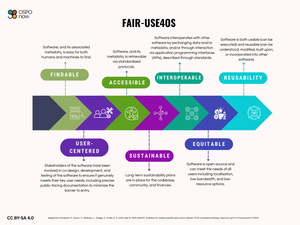
As open source communities continue to grow and evolve globally, it's important to make sure that community leaders are meeting the needs of their community participants. Inspired by FAIR principles and the recent FAIR-USE4OS adaptations for open-source, I thought about practical ways that FAIR could apply to communities.
This post outlines how you could use these ideas to build and promote open practices in your communities. Each section is grounded in actionable ideas from our own hands-on experience.

F — Findability: Help the World Discover You
Visibility is the first step to building a community. You want to find people who resonate with your project/vision, and you want them to be able to find you, too, as easily as possible. Create a dedicated website or launch social media channels to highlight your project's mission, people, and progress.
For example, consider the Data Science Without Borders (DSWB) project. Their website tells us the project aims to improve data systems in Africa by supporting the development of advanced data science pipelines in three African countries. OSPO Now is working with DSWB to help grow the community and I'm happy to be their community manager. Having visitors learn about us from the website is a great way to spark interest, and they can be continuously informed about what we do in the project through our events page.
Don't stop there: speak at conferences and community events. Visibility in person deepens connections and encourages collaboration. Another strategy? Co-locate your events with more widely known ones, such as how CHAOSScon runs alongside Open Source Summit NA, bringing in organic discovery and new contributors.
A — Accessibility: Enable Diverse Participation
Community isn't just about real-time attendees. Publish your meetings and event content on platforms like YouTube, and include captions or transcripts to welcome a broader, often multilingual audience.
Equally important is the asynchronous experience. Notes and recordings should be available so contributors in other time zones or with limited availability can stay informed. Host your code and collaboration materials on accessible platforms like GitHub, which provide clear visibility and contribution pathways. Have and encourage conversations on messaging tools like Slack and Discord or via mailing lists and newsletters. Members can communicate at their own time, and various conversations can be championed on these platforms.
I — Interoperability: Speak the Same Language
Practicing FAIR-USE4OS should also extend to the formats we use for our documents. Use simple, open file types like .md, .csv, or .txt, which are more compatible across systems than proprietary formats like .docx.
Where possible, rely on reusable, shared templates, like the Contributor Covenant for Codes of Conduct. A great example of a community using this code of conduct is the the Turing Way.
Adopting tools that work seamlessly across platforms and devices helps ensure accessibility and collaboration for all contributors. For example, JupyterHub Notebooks are compatible with various operating systems and devices, making it simpler for users to engage regardless of their setup. Framapad, a collaborative writing tool, allows real-time input without requiring sign-in, supports anonymous contributions, and uses color-coded text to differentiate between users. It's also more adaptable to screen readers, making it a more inclusive option for contributors with visual impairments. The Turing Way uses JupyterLab MyST to host the Turing Way book, and the DSWB community use Framapad to take notes during meetings.
R — Reusability: Design for Replication
Open source isn't just about visibility, it's about empowerment and enabling others to use your approach as easily as possible. When possible, permissive licences like MIT or CC BY are great to maximise reuse of your work. But any open source/access licence is a necessary signal telling others how they can reuse and adapt your work.
U — Usability: Build for Your Community's Real Needs
Meet your community where they are. Regularly run surveys or collect structured feedback, track open issues, and incorporate insights directly into project decisions. Document use cases. Track how your project is being used—and by whom.
Also, make it easy to get help. A clearly labeled #help or #ask-away channel can be the difference between a new contributor getting stuck and staying engaged.
S — Sustainability: Structure for the Long Haul
Good communities outlive individual contributors. Hold regular check-ins and reviews to evaluate your processes. Archive meeting notes, documentation, and outputs on persistent platforms like GitHub or Zenodo.
Help newcomers with onboarding guides. Don't forget offboarding too, the transparent processes for leadership transitions or even project sunsetting help ensure continuity and community trust.
E — Equity: Design with Inclusion at the Core
Language, culture, connectivity, and time zone differences shape how people engage. Translate your most critical documents, like your Wiki or Ways of Working, into languages prevalent within your community.
The Turing Way invites and supports community members to translate its documents into their own languages, encouraging contribution and localization.
Communities like CHAOSS Africa and CHAOSS Asia also encourage and support regional and cultural localization of the more global community, CHAOSS. Use tools like whena.re to accommodate time zone diversity when scheduling events.
Finally, think about low-bandwidth realities. Encourage camera-off meetings, use lightweight tools like Google Docs, and support asynchronous work styles that lower the barrier for all participants, especially those in low/under-resourced contexts.
A Shared Responsibility
Embedding these principles into open source communities is not about ticking off a checklist; but more about building a process and creating a mindset amongst your community members. By committing to building with fairness, accessibility, and equity at the center, we create spaces where everyone can contribute and grow.
The examples listed here are not an exhaustive list of ways that communities practice FAIR principles. Tag 'OSPO Now' on LinkedIn to share how you're using FAIR principles in your community.